
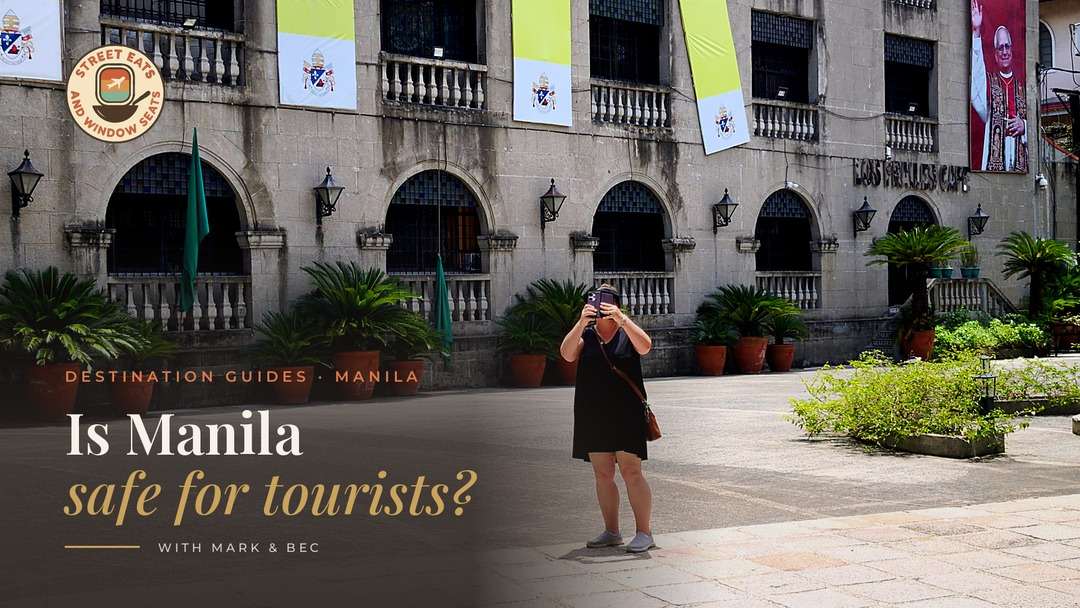
Short answer: Yes, Manila is generally safe for tourists who stick to areas like Makati, BGC and Intramuros. The real risks are pickpocketing, phone snatching and being overcharged for rides, not violent crime aimed at tourists. Use Grab, keep your phone out of sight, and avoid Tondo, parts of Caloocan and Navotas. Here’s what we actually experienced.
Let me be honest about what we thought before we went to Manila, Philippines. We kept reading that it was one of the most dangerous cities in Asia. And look, we’ve been to a lot of Asian cities that carry that same reputation — Phnom Penh, Jakarta — and the reality is almost always very different to what you read online.
Manila is no different.
Is Manila safe for tourists? What the data actually says
Here’s something that might surprise you. The Philippine National Police recorded 2,087 focus crimes nationwide from January to August 2026, down from 3,584 over the same period in 2025. That’s a drop of about 42 percent, according to PNP figures reported by the Inquirer (as of September 2026). Focus crimes cover things like theft, robbery, physical injuries, carnapping, rape and homicide. These are national figures rather than Manila alone, but they point the same way: crime is falling, not spiralling out of control.
Metro Manila specifically has had a run of good news through 2026. Under a new regional police chief who took over in late August, the NCRPO reported focus crimes down 51 percent for the first two weeks of his term compared with the same period in 2025, and other weekly reports through the year have shown drops ranging from 13 percent to 46 percent. Police credit stepped-up patrols and checkpoints under the DILG’s Safer Cities push, launched in April 2026.
None of that matches how Manila is often ranked online. Crowdsourced sites like Numbeo have rated Manila among the highest “crime index” scores in Southeast Asia, and viral, high-profile incidents, especially motorcycle-taxi robberies, keep the fear alive on social media. Philippine police have publicly asked people not to judge the city’s overall safety from isolated viral cases, and local fact-checkers have pointed out that Numbeo’s score comes from self-selected visitor surveys rather than verified police data. It measures how scared people feel searching Manila’s name online, not what the police are actually recording. That gap between the official numbers and the online reputation is a big part of why Manila still gets a scarier rap than the data backs up.
Does that mean Manila is without risk? No, and not every category fell equally. Homicide only dipped by around 3 percent in the national PNP figures above. But no major city is without risk. The biggest risks in Manila are what you’d find in any big city in the world — pickpocketing, petty scams and opportunistic crime at night. Not violent crime targeted at tourists.
Is Manila dangerous?
Parts of it can be, but they’re not the parts most tourists ever see. Manila has a big reputation, and like Phnom Penh or Jakarta, that reputation is worse than the reality. Police figures show focus crimes across the Philippines fell about 42 percent from January to August 2026 compared with the same period last year.
The dangerous areas, like Tondo and parts of Caloocan and Navotas, are well off the tourist trail. In Makati, BGC and Intramuros, the things that go wrong are small: a snatched phone, a taxi that won’t use the meter, a “helpful” stranger who wants paying.
Is Makati dangerous? No. We walked the streets off P Burgos most nights and never felt unsafe.
Where to stay and where to be careful in Manila
When Bec and I visited Manila we based ourselves in Makati and spent our days out in Intramuros, Chinatown, Quinta Market and the Makati Greenbelt. We felt comfortable everywhere we went, even when we wandered a little too far from the main streets of Chinatown and got briefly lost, which is a good reminder to keep Google Maps handy. Makati, BGC and Intramuros are the areas most first-timers stick to, and for good reason: they’re well known, well travelled areas. You can see exactly how we spent our time in our 5 days in Manila itinerary.

Intramuros does come up regularly as a place where scams and pickpockets operate because of the high concentration of tourists. Just be aware of your surroundings there. The areas you really want to avoid are Tondo, parts of Caloocan and Navotas and some of the outer districts. If you’re visiting Manila as a tourist you have no reason to go to any of those areas anyway.
Is Makati safe for tourists?
Bec and I walked around most nights in Makati along the streets off P Burgos — which, let’s be honest, is essentially a red light area. We ate there, we drank there, we people-watched there, and we never once felt unsafe. Makati is without question the best area to base yourself in Manila as a tourist.

Is BGC safe for tourists?
Bonifacio Global City, or BGC, is Manila’s modern business and shopping district over in Taguig, and it’s widely regarded as a well-developed and generally safe part of the city. We only saw a small slice of it. We spent about an hour at Market! Market! on our third day and at no point felt unsafe, but that’s not enough for us to tell you what BGC is like at night. If you want a quieter, more corporate base than Makati, it’s worth a look. Makati is the area we can properly recommend from experience.
Is Manila safe at night?
In the main tourist areas like Makati, yes. We walked around P Burgos most nights without any issues. Outside those areas, we’d stop walking and use Grab. Don’t wander alone through unfamiliar streets late at night, and keep your phone in your pocket when you’re not using it. Distracted people are the easy targets, so the habits in the tips below apply double after dark.
Practical safety tips for visiting Manila
After over 26 years of travelling as a midlife couple we’ve picked up a few habits that just become second nature. Here’s what we do.
We never have our bags hanging off us facing the road. That just makes it easy for people on motorbikes to snatch. Don’t have a big bulky wallet hanging out of your pocket. Don’t walk along staring at your phone. If someone approaches you selling something, just politely decline and keep moving.
Use Grab, not random taxis. Don’t walk late at night outside the main tourist areas and always have travel insurance just in case. That’s really all there is to it.
Always download the Grab app before you arrive. It gives you a fixed price upfront and is far safer than flagging down a random taxi. It works across all of Manila and takes about two minutes to set up.
Common scams in Manila (and how to avoid them)
The good news is that almost everything you’ll run into in Manila is a hassle rather than a danger. Below are the things we saw ourselves, plus the scams other travellers commonly report. We didn’t run into the second group, mostly because we used Grab for every ride and pre-booked our airport transfer.
Street offers on P Burgos (we saw this ourselves). Walking P Burgos Street in Makati, be prepared to be offered Viagra, fake Rolexes and services by the ladies walking the street. One morning I headed out alone for a coffee and was approached every few metres. A polite “no thanks” and keep walking is all it takes. It’s annoying, not dangerous.
Horse carriage and tour sellers in Intramuros (we saw this ourselves). Around Plaza Roma you’ll be approached by sellers wanting you to book a horse and carriage or bike tour. Other travellers report that some carriage drivers don’t mention a price until the end of the ride. If you want to do one, agree the price before you get in. If not, a polite no is enough.
Taxis that won’t use the meter, especially at the airport (commonly reported). Travel guides regularly warn about taxi drivers who refuse the meter or quote an inflated flat fare, and curbside touts at the airport are the ones people mention most. We never had a problem because we used Grab and pre-booked our transfer. If you do take a taxi, insist on the meter, or walk away and find another.
“That attraction is closed” and overly friendly strangers (commonly reported). A driver or a stranger tells you the place you want to visit is closed and offers to take you somewhere else instead. Check for yourself on Google Maps, and be wary of anyone who’s a bit too friendly and keen to walk along with you.
Money changers with rates that look too good (commonly reported). A sign advertising an exchange rate well above the market rate is the warning. Use ATMs, banks or your hotel instead, and count what you’re handed.
None of this is unique to Manila. It’s the same handful of tricks you’ll meet in most big Asian cities, and a little awareness covers all of them. For more on what travel-safety guides warn about, see World Nomads’ guide to common scams in the Philippines.
So is Manila safe for tourists?
Yes — with the same common sense you’d apply in any major city. Manila has a low risk of serious violent crime and a higher risk of the petty stuff — pickpocketing, scams, being overcharged. The biggest risk honestly isn’t getting attacked. It’s getting your phone nicked or paying too much for a ride.
Manila’s reputation is worse than its reality. If you go with realistic expectations and stay in the main tourist areas, you will be fine.
We’ve been giving straight-up travel advice for midlife couples for over 26 years. Take a look at the story behind Street Eats & Window Seats. And for everything else about visiting Manila, check out our 5 Days in Manila itinerary.
Is Manila safe for tourists?
Yes — Manila is generally safe for tourists who stick to the main tourist areas like Makati, BGC and Intramuros. The city has a low risk of serious violent crime. The bigger risks are pickpocketing, petty scams and being overcharged for transport. Common sense and basic precautions go a long way.
Is Makati safe for tourists?
Makati is one of the safest and most tourist-friendly areas in Manila. It’s well-developed, well-lit and has plenty of restaurants, bars and things to do. We walked around Makati most nights including along P Burgos Street and never felt unsafe at any point.
What areas of Manila should tourists avoid?
Tourists should avoid Tondo, parts of Caloocan, Navotas and some of the outer districts. However these areas are well off the tourist trail and you have no reason to visit them on a typical trip to Manila. Stick to Makati, BGC and Intramuros and you will be fine.
Is Manila safe at night?
In the main tourist areas like Makati, yes. Outside them, use Grab rather than walking alone late at night, and keep your phone out of sight.
Should I use Grab in Manila?
Yes — always use Grab instead of flagging down a random taxi. Grab gives you a fixed price upfront, tracks your journey and is far less likely to result in being overcharged. It works well across Manila and is the safest and most reliable way to get around the city.
Is Manila more dangerous than other Asian cities?
No — Manila’s reputation is worse than its reality. Philippine police recorded about 42 percent fewer focus crimes from January to August 2026 than in the same period of 2025. Compared to many cities in Latin America and parts of the US, Manila is considerably safer. Most Asian cities that carry a dangerous reputation are more chaotic than genuinely dangerous.
Why does Manila rank so high on online crime indexes if crime is falling?
Sites like Numbeo rank Manila using crowdsourced surveys from website visitors, not verified police data, so the score reflects how worried people feel searching Manila’s name rather than actual crime levels. Viral videos of isolated incidents, especially motorcycle-taxi robberies, also drive that perception. Philippine police have publicly said not to judge the city’s overall safety from these isolated cases. The official PNP and NCRPO figures for 2026 show crime falling, even while the online reputation lags behind.
What are the most common scams in Manila?
The most commonly reported are taxis that refuse to use the meter (especially at the airport), horse carriage drivers who don’t state a price until the end, money changers offering rates that look too good, and ‘that attraction is closed’ stories. On P Burgos in Makati you’ll also be approached by street sellers and touts. Using Grab and agreeing prices upfront avoids most of it.